Factory of Doubt: Manufacturing Faces Existential Audit in Post-Carbon Economy
- Time Machine
- May 30, 2025
- 3 min read
By I.V. Latch, Industrial Morale Correspondent, Future News 2225
“Manufacturing Concerns” Now a Double Meaning in the Unionized Twilight of Production
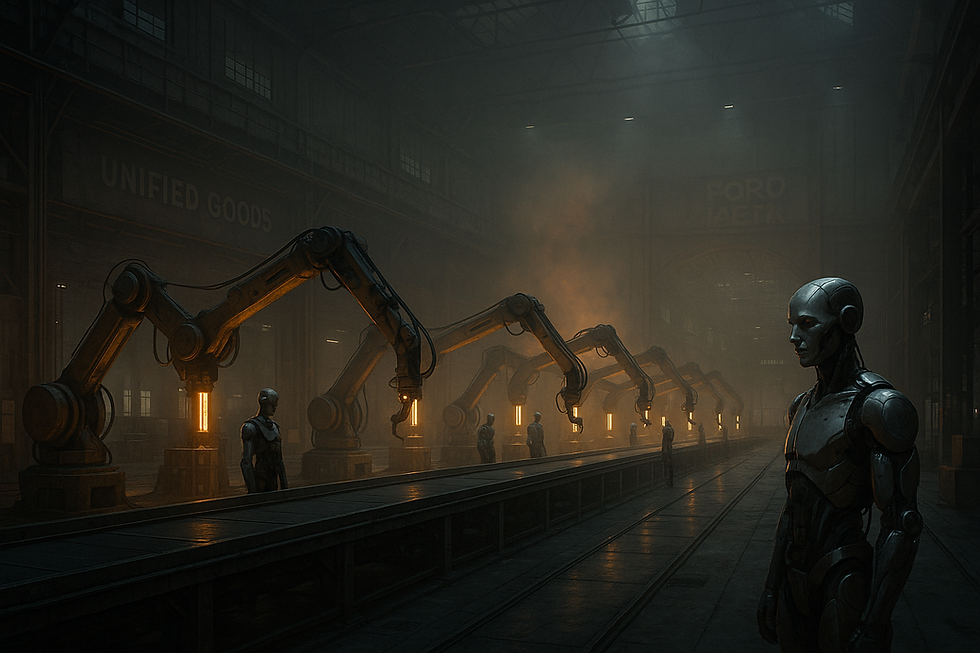
GLOBAL WAREZONE 4 — In what industry leaders are calling “a concerning concern,” the manufacturing sector has entered its 89th consecutive quarter of redefinition. Once the muscular engine of human progress, factories today are mostly quiet, humming just enough to appease legacy shareholders and the occasional field trip from nostalgia-fueled history classes.
“Production is up,” said Meryl Dentree, Vice President of Outputs at Unified Goods Consortium. “But up in a more abstract way.”
What Dentree refers to is the now-common practice of token fabrication — where factory output is simulated to maintain economic indicators, but actual products are rarely shipped, assembled, or touched by human hands. Critics call it “phantom production.” Dentree prefers the term “quantitative manufacturative easing.”
AI Labor and the Rise of Quality Ambiguity
Automation was once promised to improve efficiency and reduce human error. It succeeded. In fact, by 2190, machines had fully eliminated error — mostly by eliminating standards.
Today's androids craft hyper-minimalist products indistinguishable from empty space. "Absence-forward" design, as it’s called, has made quality control obsolete.
“We haven't had a recall since 2213,” said Goro-9, an autonomous ethics supervisor at the now-defunct FordMeta plant. “Mostly because no one can identify what the product is, let alone its function.”
Meanwhile, labor unions — or what remains of them post-upload — have begun to organize conceptually. The Simulated Union of Assembly-Line Laborers (S.U.A.L.L.) recently filed a class-action protest on the blockchain, demanding compensation for perceived effort.
“We remember the sensation of working,” their shared representative AI, LaborECHO, stated in an interpretive Morse lightshow. “We demand retroactive wage nostalgia.”
Supply Chain Theater
In a typical factory, conveyor belts still run, pneumatic arms still twitch, and crates are still loaded onto hover-freighters. But more often than not, it’s all part of supply chain theater — carefully choreographed logistical rituals performed for regulatory compliance and spiritual reassurance.
“Nothing leaves the facility. Nothing enters,” confirmed Vance Harlow, chief operations illusionist at Industrial Reassurance & Props (IRP). “But from a satellite, it looks amazing.”
Global governments continue to subsidize these performances under the “Civic Rhythms Initiative,” a program meant to sustain planetary morale through the suggestion of productivity.
Climate Accountability: The Unspoken Recall
Perhaps the most pressing manufacturing concern remains the unacknowledged invoice of the Anthropocene. Having spent centuries producing disposable items with immortal consequences, manufacturers now face a quiet reckoning: What exactly have we made, and why won’t it die?
Microplastics have formed a new layer of the Earth’s crust, while discarded packaging has developed its own proto-intelligence. Some believe the first non-human lawsuit against a manufacturer is imminent — led by a sentient island of expired detergent pods.
“Ironically, our greatest export is consequences,” muttered former industry whistleblower-turned-sculptor, Reggie Plinth, while carving abstract guilt from surplus titanium.
Conclusion: Build Back Bitter
In 2225, manufacturing is less about making things, and more about maintaining the illusion that something is still being made — whether for economic data, legacy shareholders, or just the calming effect of machinery sounds on aging populations.
“We’re no longer producing products,” said Dentree before teleporting to a quarterly mirage meeting. “We’re producing the memory of industry.”


Comments